
 EN
EN



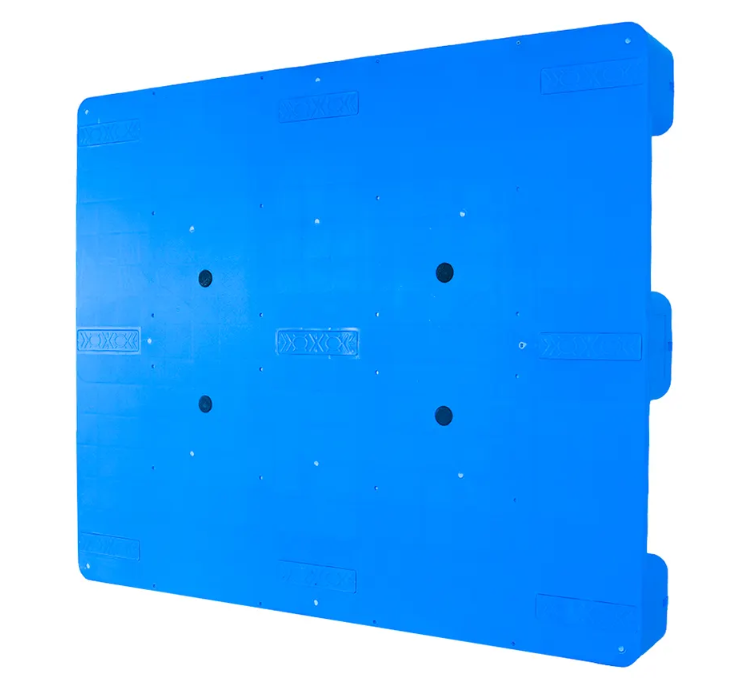
What Makes a Pallet Truly Rackable? Structural Fundamentals of Rackable Plastic Pallets
Load Span, Beam Support Integrity, and Racking-Specific Deflection Limits
Rackable plastic pallets are engineered specifically to transfer load safely across rack beams—not just support weight on the floor. Unlike standard pallets, they must resist point-loading, slippage, and excessive deflection when suspended at height. Key structural requirements include:
- A minimum 2-inch beam contact surface to prevent lateral movement or disengagement
- Reinforced leg and stringer geometry that channels approximately 80% of applied load directly into vertical supports
- Deflection limited to 0.25 inches under full rated load, per ASTM D6252—the benchmark for racking suitability
Standard plastic pallets often buckle or twist under beam support, contributing to 15–20% higher incident rates in racking environments. This is because warehouse floors distribute force broadly, while rack systems concentrate it at discrete contact points—demanding precision reinforcement in both structure and material.
Material Rigidity vs. Creep Resistance: Why Standard Plastic Pallets Fail in Racking
Most conventional plastic pallets prioritize initial stiffness over long-term dimensional stability—a critical flaw in racking applications. Polyethylene-based units, for example, undergo measurable creep (time-dependent deformation) under sustained loads: up to 0.3–0.5% monthly dimensional loss at 70°F, per the Plastics Industry Association’s 2024 PACT report. Rack-certified alternatives counter this with:
- Cross-braced HDPE frameworks that retain approximately 98% original shape after six months of continuous loading
- Glass-fiber reinforcement embedded in high-stress zones to inhibit permanent deformation
- Thermally stabilized polymer blends that minimize expansion/contraction across operational temperature ranges
Non-rackable plastic pallets exhibit roughly three times the creep rate of certified rackable units—explaining why 62% of documented plastic pallet failures in racking involve non-compliant designs. Unchecked creep leads to progressive beam misalignment, uneven stress redistribution, and eventual deflection beyond safe thresholds—often within weeks of deployment.
Matching Rackable Plastic Pallets to Your Racking System Type
Selective, Drive-In, Push-Back & Pallet Flow Racks: Bottom Design (Pod Feet vs. Full Deck) and Entry Compatibility
Rackable plastic pallets are not one-size-fits-all—their bottom configuration must align precisely with your racking system’s mechanics.
- Selective racks, which rely on direct forklift access to individual pallet positions, require pallets with pod feet: elevated support points that clear horizontal beams while maintaining stability during insertion and removal.
- Drive-in, push-back, and pallet flow systems, by contrast, depend on uninterrupted rail support across the pallet’s underside. Here, full-deck designs are essential to prevent sagging, binding, or premature fatigue under dynamic loads.
Mismatched pairings contribute to 23% of warehouse racking incidents, according to the Warehouse Safety Council’s 2023 analysis. Entry compatibility further refines selection: drive-in configurations demand reinforced corner blocks to absorb repeated impact; pallet flow systems require low-friction bases (e.g., integrated UHMW inserts) to ensure consistent, controlled movement without stalling.
Dimensional Tolerance, Load Center Alignment, and Orientation Stability in High-Density Racking
High-density racking magnifies the consequences of minor deviations. Tight tolerances aren’t optional—they’re foundational to safety and throughput.
- Dimensional tolerance must be held to ±3 mm to avoid jams in narrow push-back lanes or pallet flow chutes.
- Load center alignment is equally critical: misalignment exceeding 50 mm increases localized beam stress by 40%, accelerating metal fatigue and reducing rack service life (Material Handling Institute, 2024).
- For orientation stability—especially in flow lanes—pallets benefit from textured anti-slip surfaces and interlocking features that prevent rotation or lateral drift during acceleration or deceleration.
Storage capacity varies significantly by rack type—even with identical footprint and depth:
| Rack Type | Depth | Pallets/Bay | Relative Capacity |
|---|---|---|---|
| Drive-In | 5-deep | 25 | Baseline |
| Push-Back | 5-deep | 50 | +14% |
| Pallet Flow | 5-deep | 50 | -10% |
Table: Storage capacity variance per rack type under identical footprints
Crucially, all these efficiencies assume even weight distribution across supporting beams. Concentrated loads accelerate creep-related deformation—and compromise the very advantages high-density systems promise.
Validating Real-World Load Capacity for Rackable Plastic Pallets
Static, Dynamic, and Racked Load Ratings: Interpreting ASTM D6252 and ISO 10415 Test Protocols
True rackability isn’t inferred—it’s validated through standardized testing that replicates real-world stress profiles. Three distinct load ratings define performance boundaries:
- Static load capacity reflects maximum weight the pallet can bear when stationary on level ground—typically 5,000–25,000 lbs depending on construction. It measures base integrity but does not predict racking behavior.
- Dynamic load capacity, usually 30–50% lower than static, assesses safe handling limits during transport—factoring in impact, torsion, and momentary overloads. ISO 10415 governs this test, emphasizing shock absorption and corner durability.
- Racked load capacity, the most operationally relevant metric, quantifies how much weight the pallet can safely hold while supported only on two parallel beams. Governed by ASTM D6252, this test applies asymmetric loads over 15–30 minute intervals, measures deflection at critical nodes, and mandates approximately 2% permanent deformation post-test. A typical rackable plastic pallet sustains 1,100–2,200 lbs in this mode—significantly less than its static rating due to concentrated beam pressure.
Always verify test reports specify load-center positioning matching your actual use case (e.g., centered vs. offset), as small shifts dramatically affect beam engagement and deflection.
| Load Type | Test Focus | Industry Standard | Key Limitation Factor |
|---|---|---|---|
| Static | Stationary compression | ASTM D6252 | Base support integrity |
| Dynamic | Movement stress | ISO 10415 | Impact resistance |
| Racked | Beam-supported storage | ASTM D6252 | Beam contact deformation |
Long-Term Performance: Assessing Creep, Fatigue, and Beam Loading Under Continuous Rack Stress
Plastic pallets face three unique degradation pathways in racking—none of which meaningfully affect wood equivalents:
- Creep: Gradual, irreversible deformation under constant load. Untested or low-grade HDPE may sag >4% after six months; premium cross-linked formulations limit this to approximately 1.5% after 1,000 hours at 80% load.
- Fatigue: Micro-crack formation from repeated loading/unloading cycles—particularly accelerated in cold environments (<32°F) where plastics become more brittle.
- Beam loading stress: Concentrated force at beam-pallet contact points can trigger buckling in non-reinforced legs or unsupported deck zones.
Robust validation goes beyond minimum standards. Look for units tested under accelerated conditions simulating:
- 10,000+ load/unload cycles
- Temperature swings from −20°F to 140°F
- 90-day continuous load application at rated capacity
These protocols help project five-year performance with confidence—especially vital in high-density deployments where pallet failure carries cascading risk.
Safety, Compliance, and Operational Best Practices for Rackable Plastic Pallet Deployment
Deploying rackable plastic pallets requires disciplined integration—not just procurement. OSHA 1910.176(b) mandates documented weekly inspections of pallet integrity, beam engagement, and load positioning. Non-compliance exposes facilities to penalties up to $156,259 per violation, per OSHA’s 2023 penalty schedule.
Critical safeguards include:
- Never exceeding manufacturer-specified beam deflection limits—typically approximately L/200 (where L = beam span in inches)
- Keeping loads centered within 6 inches of beam centerlines; off-center placement accounts for 42% of racking failures
- Requiring forklift operators to confirm full, flush seating on crossbeams before departing the bay
Proactive training—conducted quarterly—is equally vital. Curriculum should cover:
- Core weight distribution principles (e.g., how load offset multiplies beam stress)
- Damage identification (e.g., cracks >3 mm, leg warping, or delamination require immediate removal)
- Safe dynamic handling during retrieval, especially in deep-lane or flow systems
Facilities using continuous monitoring and scheduled training report a 67% reduction in racking-related incidents, versus those relying solely on reactive maintenance.
FAQs
What are the main differences between rackable and standard plastic pallets?
Rackable plastic pallets are designed specifically to support loads safely across rack beams, whereas standard plastic pallets are not. Rackable pallets feature key structural enhancements such as a minimum 2-inch beam contact surface, reinforced leg and stringer geometry, and specific deflection limits.
Why are non-rackable pallets more prone to failure in racking systems?
Non-rackable pallets often lack the necessary reinforcement and material resistance to prevent creep and deformation under the concentrated stress points of racking systems. This can lead to progressive misalignment and increased failure rates.
How does load rating affect the selection of rackable pallets?
Load ratings define the maximum weight capacity under different conditions: static, dynamic, and racked. It’s crucial for the selected pallet to meet the operational demands based on these ratings to ensure safe and efficient use.
What are the compliance requirements for rackable plastic pallets in facilities?
Facilities must adhere to OSHA guidelines, which include documented weekly inspections of pallet integrity and beam engagement. Compliance with these standards helps avoid significant penalties and ensures operational safety.
Table of Contents
- What Makes a Pallet Truly Rackable? Structural Fundamentals of Rackable Plastic Pallets
- Matching Rackable Plastic Pallets to Your Racking System Type
- Validating Real-World Load Capacity for Rackable Plastic Pallets
- Safety, Compliance, and Operational Best Practices for Rackable Plastic Pallet Deployment
- FAQs

